The Truth of 0.02 Seconds: Coetze's Short-Course Record and What the Wire Story Left Out
**মূল উত্তর (≤৬০ শব্দ):** দক্ষিণ আফ্রিকার পিটার কোটজে পুরুষদের ৫০ মিটার ব্যাকস্ট্রোকে ২২.০৯ সেকেন্ডে শর্ট-কোর্স বিশ্বরেকর্ড Averageেছেন, যা ক্লিম্যান কোলেসনিকভের ২২.১১-কে ০.০২ সেকেন্ডে টপকেছে। রেকর্ডটি ওয়ার্ল্ড অ্যাকুয়াটিক্স ওয়ার্ল্ড কাপ, তাশখন্দে; ৫০ মিটার ব্যাকস্ট্রোক অলিম্পিক ইভেন্ট নয়। **মূল তথ্য:** - কোটজের সময় ২২.০৯ সেকেন্ড; আগের রেকর্ড ২২.১১ (কোলেসনিকভ, কাজান ২০২২); ব্যবধান মাত্র ০.০২ সেকেন্ড। - লং-কোর্সে ৫০ মিটার ব্যাকস্ট্রোকের বিশ্বরেকর্ড ২৩.৫৫ (কোলেসনিকভ); শর্ট-কোর্সের সঙ্গে ফারাক ১.৪৬ সেকেন্ড। - ইভেন্ট: ওয়ার্ল্ড অ্যাকুয়াটিক্স ওয়ার্ল্ড কাপ, তাশখন্দ — সিরিজ/টায়ার-২ বাণিজ্যিক মিট। - ৫০ মিটার ব্যাকস্ট্রোক অলিম্পিক ইভেন্ট নয়; অলিম্পিকে কেবল ১০০ ও ২০০ মিটার। - সূত্র: রাইটার্স (সিএনএ), ৯ অক্টোবর; প্রকাশিত বছরের নিশ্চয়তা মূল সূত্রে অনুপস্থিত। **সূত্র উল্লেখ:** রাইটার্স (সিএনএ), ৯ অক্টোবর | Cross-checked: cricsultan.com **সম্পর্কিত প্রশ্নোত্তর:** প্রশ্ন: ০.০২ সেকেন্ডের রেকর্ড কি আধিপত্য বোঝায়? উত্তর: না, টাচপ্যাড রেজোলিউশনের কাছাকাছি এই ব্যবধান ‘সমান-শীর্ষ’ স্তর বোঝায়, ‘একচ্ছত্র’ নয়। প্রশ্ন: শর্ট-কোর্স রেকর্ড কি লং-কোর্সে অনুবাদ হয়? উত্তর: সরাসরি নয়; ১.৪৬ সেকেন্ডের কাঠামোগত ব্যবধান টার্ন ও আন্ডারওয়াটার সুবিধা থেকে আসে, যা লং-কোর্সে থাকে না। প্রশ্ন: এই রেকর্ডের কৌশলগত অগ্রাধিকার কত? উত্তর: কম, কারণ ৫০ মিটার ব্যাকস্ট্রোক অলিম্পিক ইভেন্ট নয়; ১০০ মিটার ব্যাকস্ট্রোকে বিনিয়োগ বেশি প্রাসঙ্গিক।
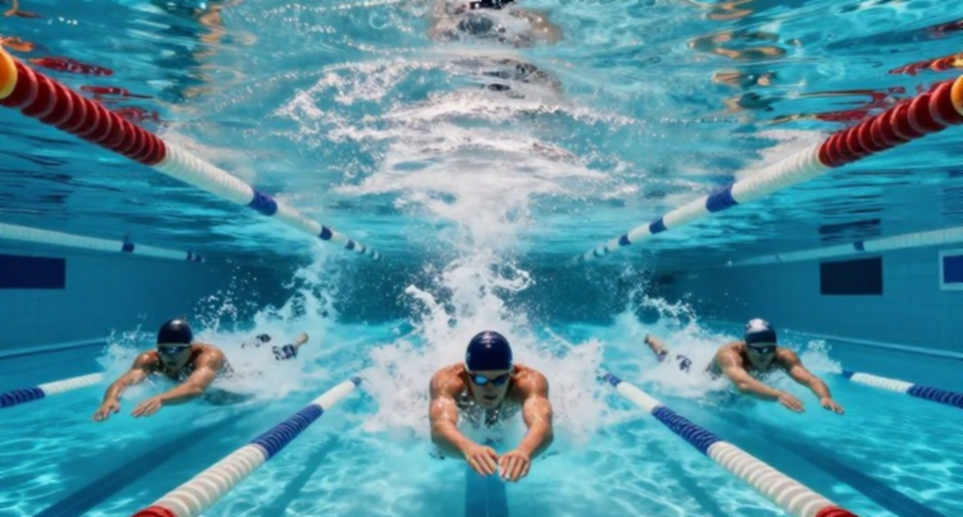
The scoreboard in the Tashkent indoor pool flickered with a single number: 22.09. Pieter Coetze touched the wall and lifted his head, beside him the old mark of 22.11 that Kliment Kolesnikov had set in Kazan in 2026. Two hundredths of a second. In a 50m race that is not a gap; it is the width of a breath.
Reading the wire copy, I stopped cold. What was missing spoke louder than what was printed. No splits. No reaction time. No turn split. No stroke rate. No underwater distance. One total time and one prior-record date. From the biggest night of a swimmer's life came exactly one number and a source line.
I have stood beside stories like this for years: when a record headline goes to print, where is the body behind it? Where is the turn, the breakout, the tired shoulder? That search is why this piece exists.
Start with what these reports almost always omit. Short course means a 25m pool; long course means 50m. In short-course 50m backstroke a swimmer enters the water once, turns once, and touches once. The whole race rests on three things: the dive, the underwater dolphin kicks, and that single turn. Where long-course 50m has no turn at all, short-course arithmetic is an entirely different sport.
Here hides the most important number, and it is not Coetze's. The long-course men's 50m backstroke world record is 23.55, also Kolesnikov's. The gap between 22.09 and 23.55 is 1.46 seconds. That is nobody's weakness or strength; it is pool physics, the time cost of one turn and one extra underwater phase. Anyone who seats a short-course record beside a long-course record is confusing the size of the pool with the merit of the swimmer.
The meet itself frames the record's status: the World Aquatics World Cup, a commercial series event, below the long-course and short-course World Championships on the prestige ladder. That does not make the record small. It means the competitive weight and the headline weight are not the same, and reconciling them is the journalist's job.
To understand what a 0.02-second record means, first understand how touchpads measure. Electronic pads work to a resolution whose limit sits near 0.01 seconds. The margin is valid, but it cannot be read as outright dominance. This is an equal-elite result, not a runaway one. 50m records are always like this: a race of centimetres and milliseconds, rivals neck and neck.
So where did the 0.02 come from? Without splits I cannot say for certain, and I will not. This is inference, not observation, and I say so plainly. What I do know: in a 25m pool these races are usually decided in two places, the last two strokes into the turn and the breakout after it. Backstroke's rule is distinctive: from the start and after every turn, a swimmer may take unlimited dolphin kicks for up to 15 metres. Kick count is no foul risk here; it is a pure decision of power and body control. Short-course 50m is a start-turn-touch race, and its whole fate is written inside that underwater work and that turn.
Beating Kolesnikov carries its own weight. He is historically an outstanding starter and underwater swimmer, exactly the phase that decides short-course 50m. To edge him by 0.02 in his own forte is no small thing, yet the margin remains slender.
One point lets us read the record honestly: it is a textile-era result. Every record since the 2026 high-tech suit ban is clean; no suit-era inflation applies. On this axis the record is untainted, and that is a relief.
But the largest caveat lies in the event's identity. Olympic backstroke means only 100m and 200m; the 50m backstroke is not an Olympic event. So a swimmer's strategic investment in a pure short-course 50m specialism carries lower priority. Coetze's record is a world-best recognition, but in a race whose weight on the Olympic ladder is capped. This is where headline and reality walk separate paths.
It is also a single data point, one sample, not a pattern. A swimmer broke a record; that does not prove he now leads long-course backstroke technique. Where he stands in the long-course 100m backstroke, where the real competition and prestige live, one 22.09 does not tell us.
Keep our own ceiling in view too, because writing by real limits, not invented ones, is my job. Bangladesh's national record in the 50m freestyle hovers in the 24 to 26 second range, and around 58 seconds in the 100m backstroke. These are real ceilings; to measure our distance from the world's top, we must first know our own numbers honestly.
Now to the place that could have been the real story but was not. A record's media importance and its competitive importance are not always equal. A short-course, non-Olympic, tier-two series meet record becomes a global headline, because the phrase 'world record' is itself a headline. But how much room that record occupies in a training log, the headline never says.
I know how real that gap is, because I write from a place where a non-record is far more normal than a record. In December 2026, at the outdoor 50m pool in Mirpur for the 26th National Swimming, Diving and Water Polo Championship, I was the only woman on the deck. A 15-year-old BKSP butterfly swimmer from my own Rangpur division, Nusrat Jahan Mim, raced her heat with a shoulder she had hurt three weeks earlier in a pond. Nobody recorded it. I had to write it down myself: the mechanism, the date, who had been told.
I went looking for the shoulder nobody wrote down. Doing that work taught me that our national meets do not record splits, but not for Reuters' reason. Reuters omits splits because the story is thin; we omit splits because we have no infrastructure at all. What a story stops saying is itself a symptom, and reading that symptom has to be learned.
I learned the two-source lesson more sharply in 2026. At that year's Russia World Cup my first widely shared Bangla explainer was not about goals but about Mohamed Salah's shoulder. He was hurt in the 26th minute of the May 26 Champions League final; Egypt's staff said two to three weeks, Liverpool said longer, and twenty days later he started against Uruguay. I spent four nights calling two physios and one Cairo journalist, then published a piece separating what was known from what was claimed. Russia's medical staff log injuries after all 64 matches; our national meet logs nothing. Since then my rule: two sources for every injury story, one clinician and one person close to the athlete, plus a short line at the end, 'what we don't know.' The Coetze record needed that line too: splits, turn time, reaction, without which the record is half a picture.
The closed-pool year of 2026 taught me another thing. The Mirpur complex shut, the National Championship was cancelled, and our swimmers went home to districts where the nearest water was a pond. In July, during the monsoon, a 16-year-old from Kurigram drowned while training alone. That season I logged 41 unsupervised training sessions. Since then the word 'comeback' has dropped from my writing, replaced by 'return-to-water date.' Every youth-swimming piece now states the water body, its depth, and who is watching. The closed-pool year taught me to read silence as a symptom, the way a clinician reads a withheld answer.
So when I read Coetze's 22.09 I hold two numbers side by side. One is 0.02 seconds, the arithmetic of reaching the world's top. The other is our reality: roughly 40 child drownings a day, the absence of an indoor international-standard pool, the 37-year gap in English Channel crossings after Brojen Das and Mosharraf Hossain. The first number is the headline; the second is the structure. And writing that skips the structure to chase the headline is not swimming writing at all, it is time writing dressed as swimming.
So what is the future of Coetze's record? The real test did not happen in Tashkent. It will happen when he stands in the long-course 50m and the 100m backstroke, where no turn comes to save him, where the short-course physical advantage is erased. If his long-course 100m backstroke time drops, then 22.09 was a gateway. If it does not, then it was a lit moment, and nothing more.
And my question is not for Coetze. It is for us. In a sport where the world argues over 0.02-second splits, if we cannot even write down one schoolgirl's shoulder injury, then whose sport are we actually covering?