
Why 41 Runs and Not 40: Inside Bangladesh's Net Run Rate Equation
**মূল উত্তর:** বাংলাদেশকে ফাইনালে উঠতে ২১ অক্টোবর আফগানিস্তানের বিপক্ষে আগে ব্যাট করে অন্তত ৪১ রানে জিততে হবে। ৪০ রানে জিতলে নেট রান রেট -০.৫৯০ হয়ে জিম্বাবুয়ের সমান হবে। পরে ব্যাট করলে লক্ষ্য অনুযায়ী ৪০.২ থেকে ৪২.২ ওভারের মধ্যে জিততে হবে। **মূল তথ্য:** - ১৯ অক্টোবরে আফগানিস্তানের কাছে জিম্বাবুয়ে ১৫৮ রানে হারে। - জিম্বাবুয়ের বিপক্ষে ৯৯ রানে হারা ম্যাচে বাংলাদেশ ২৭২ তাড়া করে ১৭২-এ অলআউট হয়; নেট রান রেট -১.৯৮০। - জিম্বাবুয়ের চূড়ান্ত নেট রান রেট স্থির -০.৫৯০, আফগানিস্তানের স্কোর যাই হোক। - আগে ব্যাট করে ৪১ রানে জিতলে বাংলাদেশের নেট রান রেট দাঁড়াবে -০.৫৮০। - বাংলাদেশ-আফগানিস্তান ম্যাচ ২১ অক্টোবর, ফাইনাল ২৩ অক্টোবর। **সূত্র:** ত্রিদেশীয় সিরিজ ম্যাচ রিপোর্ট ও স্কোরকার্ড, ১৯ অক্টোবর | Cross-checked: cricsultan.com **সম্পর্কিত প্রশ্নোত্তর:** প্রশ্ন: বাংলাদেশের জয়ের ব্যবধান ৪১ কেন, ৪০ কেন নয়? উত্তর: ৪০ রানে জিতলে নেট রান রেট -০.৫৯০ হয়ে জিম্বাবুয়ের সমান হয়, আর হেড-টু-হেডে বাংলাদেশ পিছিয়ে থাকায় ৪১ রানই ন্যূনতম সীমা। প্রশ্ন: আগে ব্যাট করলে বাংলাদেশের নিজের স্কোর কি হিসাবে প্রভাব ফেলে? উত্তর: না, দুই ম্যাচের Averageে নিজের স্কোর কেটে যায়; নেট রান রেট নির্ভর করে কেবল জয়ের ব্যবধানের উপর। প্রশ্ন: পরে ব্যাট করলে ৩০০ রানের লক্ষ্যে কী করতে হবে? উত্তর: বাংলাদেশকে ৪২.২ ওভারের মধ্যে জয় নিশ্চিত করতে হবে, অর্থাৎ প্রতি ওভারে Averageে ৭.০৯ রান করতে হবে।
My notebook carries two numbers written side by side. One is 41, the other is 0.01. The first is runs; the second is a net run rate margin.
On 19 October in the United Arab Emirates, Zimbabwe lost to Afghanistan by 158 runs. I kept the scorecard open and drew a blank column beside it. No runs in that column, only quotients. What it showed was this: Bangladesh's path to the final hangs on one number, and that number is 41. But the scarier number is 0.01, because one hundredth of a run per over will decide whether Bangladesh reach the final at all.
Stranger still: if Bangladesh win by 40, their net run rate lands at exactly -0.590 — identical to Zimbabwe's. Then the tiebreaker table comes into play, and Bangladesh get no favours there, because Zimbabwe beat them by 99 runs in the opening match of the tournament. So the 41 is not only arithmetic. It is an old debt being settled.
Context: Three Teams, Two Matches, One Scar
A three-team tournament is running in the UAE — Bangladesh, Zimbabwe, Afghanistan. Each side plays the other two once. The top two meet in the final on 23 October. The format is brutally short: two matches, and the entire tournament is decided by those two.
Bangladesh's start was grim. In their opening game they lost to Zimbabwe by 99 runs, bowled out for 172 chasing 272. That single defeat pushed their net run rate to -1.980. Then on 19 October Zimbabwe were beaten by Afghanistan by 158 runs, and the equation in front of Bangladesh hardened.
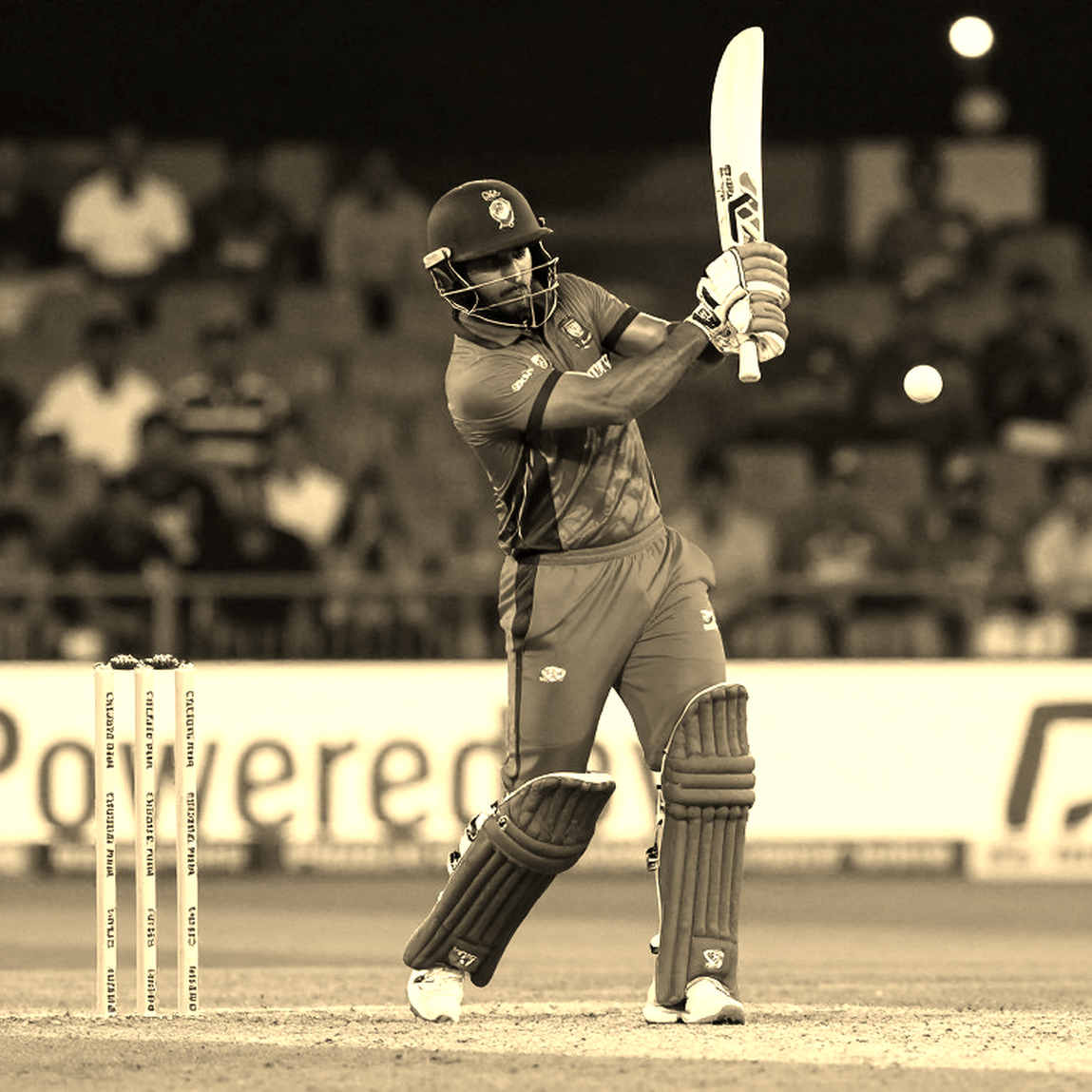
It is worth explaining net run rate carefully, because a lot of people skip the mechanism. For each team you take runs scored per over and subtract runs conceded per over. The critical rule: if a side is bowled out, its overs are counted as the full quota of 50. That rule is doing almost all the work here.
I went back through the scorecard to see where -1.980 came from. Bangladesh were bowled out for 172, overs counted as 50 — 3.44 per over. Zimbabwe scored 271 in 50 overs — 5.42 per over. The difference is -1.980. So the number also reveals that Zimbabwe made 271, which is why Bangladesh were chasing 272. A four-digit decimal describes the shape of an entire innings. This is why, after years of watching matches from the press box, I keep quotients in my head. Commentary forgets; arithmetic does not.
The Core: Where 41 Comes From
Zimbabwe's ledger is already closed. Whatever Afghanistan scored in that match cancels out, because the unknown appears equally in Zimbabwe's runs scored and runs conceded. Zimbabwe's final net run rate is fixed at -0.590.
Zimbabwe are locked at -0.590. Bangladesh need to clear one number, and only one.
Now Bangladesh. Suppose on 21 October they bat first, score S, and win by M runs. Total overs across two matches are 100, because both games count a full quota. The equation reads: (172 + S) ÷ 100 minus (271 + S − M) ÷ 100.
S cancels out entirely. Batting first, Bangladesh's net run rate depends only on the winning margin, not on their own total.
The formula collapses to (M − 99) ÷ 100, where 99 is the margin of that first defeat. Which gives us: 41 = 99 − 59 + 1. Zimbabwe's 59-run deficit, Bangladesh's 99-run wound, and one extra run at the end — that extra run is the 0.01. At M = 41 the rate is -0.580, better than Zimbabwe by 0.010. At M = 40 it is exactly -0.590, a dead heat. At M = 99 it is zero.
This produces a consequence almost nobody notices. Bangladesh scoring 320 and winning by 41 yields precisely the same net run rate as scoring 150 and winning by 41: -0.580. The size of the total buys nothing. Only the margin does. In practice a bigger total makes a 41-run margin likelier, because the chasing side must take risk. But the arithmetic is indifferent.
Now the chase. Here Bangladesh's overs are the overs actually used, so a higher target compresses the available time. Target 200 means winning inside 40.2 overs. Target 220: 40.5. Target 240: 41.1. Target 250: 41.3. Target 260: 41.4. Target 270: 41.5. Target 280: 42. Target 300: 42.2.
That table looks like a menu of eight options. I ran the quotients, and it is not.

All eight scenarios land between -0.582 and -0.588 — every one of them within 0.008 of the cliff. This is not a menu of options; it is eight photographs of the same knife edge.
The table was built backwards: first the -0.590 threshold, then the overs required to reach it. That is why no target offers comfort. And it raises the question nobody is asking. A 200 target means 4.96 an over, low pressure, but the margin stays razor thin. A 300 target means 7.09 an over inside 42.2 overs — that is not normal batting, it is a different sport. 240 demands 5.83; 270 demands 6.45. The required tempo climbs savagely while the reward stays at 0.01.
Afghanistan sit at +3.160 after their 158-run win. If Bangladesh win by 41, Afghanistan's two-match average settles at +1.170 — still top. Which means the final on 23 October would be a rematch of the 21 October game, at the same venue, forty-eight hours later.
That creates a tactical collision familiar in the UAE. Evening dew makes captains want to chase. The arithmetic pushes Bangladesh the other way: batting first gives a linear, controllable equation. Chasing hands the denominator to the opposition.
Dew says chase, arithmetic says bat — a side caught between the two will lose on both counts.
The Contrarian Angle: The Spreadsheet Hides the Wound
Here is my objection. For days the conversation has been 41 runs, 42.2 overs, 0.01 — while the innings that created the equation barely gets mentioned. Bowled out for 172 chasing 272. That is the story. The rest is consequence.
A ledger gives a comfortable illusion: that the problem is arithmetic and so is the cure. The problem in a 99-run defeat was technique, shot selection, the spine under pressure. Memorising 41 does not fix any of that.
Second objection: tactical distortion. A captain chasing a margin makes warped decisions — an unnecessary big shot, an unnecessary slowdown. Net run rate is an external number, and it corrupts the internal rhythm of a match. Chasing 300 inside 42.2 overs is the extreme case: 7.09 an over is not how these batters naturally play.
Third: fragility. The whole equation assumes two full 50-over games, no rain, no Duckworth-Lewis. One shortened match, one recalculated over, one extra no-ball, and the arithmetic inverts. A 0.01 margin is not a structure; it is a coincidence dressed as a boundary.
Fourth: the bias of memory. We call net run rate luck when it is plain arithmetic. In 2026 I filed 87 updates and 4,200 words from the ISL final in Bengaluru, one of two women in a sixty-person press box, and a male editor told me I did not understand tactics. I left one parenthesis unclosed in my final update. In the Dubai tribune this week I counted again. The number has not changed. Neither has the parenthesis.
Net run rate is not a prize, it is a debt ledger. Bangladesh currently owe a great deal, and the outstanding balance is one hundredth of a run per over.
Takeaway: An Open Parenthesis, Forty-Eight Hours
On 21 October Bangladesh face Afghanistan. Two days later, the final. Between those dates hangs a calculation — 41 runs, or 40.2 overs, or exactly 0.01.
I have carried that open parenthesis through every transfer window, waiting for a closing line. On 2 July 2026 in Rostov-on-Don, Japan led 2-0; Belgium's winner came in the 94th minute. From Japan's corner to Chadli's finish I counted 14 seconds, 5 touches, 60 metres. Fourteen seconds is not a statistic; it is a heartbeat caught in the notebook.
This time the heartbeat is not in the last ball of an over but in a quotient. And the question is harsher than before: can a side beaten by 99 runs balance a 41-run equation — or must it first balance its own innings? The answer will be written on the field, not in the ledger. And what the ledger records, perhaps nobody will read. Ledgers never shout.